Showing posts with label acting. Show all posts

Sunday, July 1, 2012

Melancholia


The woman on the moon is being forced to the earth

she's brought with her, cheese curds in her breasts


her milky breasts dripping tears of her temper --

Gentle Ophelia, she of crazy hormones.


Why not end a world with a cosmic bang

why not go down with a stymied prince


a secret assassination first, R and G, the stab

through the arras, you, he, and a whole world, boom.


.

Sunday, December 11, 2011

I Am Who


Michelle Williams as Marilyn Monroe.  

Charlotte Rampling as Charlotte Rampling.

Two films:  The Look and My Week With Marilyn.  These movies will get unequal public attention, yet they deal with very similar issues.  How does a public person, one known for physical beauty, form an art despite the beauty?  

I'd argue that Michelle Williams does, just as she inhabits the character of Marilyn, who died trying.  

Marilyn owned the screen, and if memoirs are right, had the personal chops to fill a room and dig holes in the psyche of those favored and cursed around her.  Monroe played, most successfully and often, comedic roles -- yet she yearned to be a serious actress consonant with the 'method' age in which she worked.  We might watch Bus Stop or The Misfits, but we remember Some Like It Hot or The Seven Year Itch.

Williams has the moves down.  The glances, the gallery-pleasing photo moves, the reclining postures, the depressive panics.  Women befriend or mother her.  She stuns or bewilders men.  Sometimes Marilyn's conditions are right, and a project completes.  This is the film world well-handling the real world of the film world. 


Charlotte Rampling, in The Look, isn't playing herself.  She is herself.  


This is documentary.  It's about her as an actress, and it does intersperse cuts from movies in which she's acted.  

She talks about acting, and in one interesting scene, she and her son, who's directing the actual film we're watching, engage in a stare-down, phrase-response acting exercise, wherein they repeat a random line back and forth and form a dramatic moment between one another.  At points, they 'blink' and move to another line conjured up by the context and continue on.  Fascinating.  

Yet she declares that such exercise bores her.  By contrast, we see her interacting -- for real -- with men and women whose artistic projects she shared -- novelist, photographer, poet, artist -- and with confidantes and friends.  Even, occasionally, random strangers.

Rampling, almost always in her film persona, plays the neurotic, the distant, the stern, the corrupt, the determined, the strong, the disarranged, the sinister, the seductive.  Some like it cold.  In The Look, we do see her British-French humor come out among close relationships.  Whatever the mood, she makes clear -- explains in the serious parts of her conversations -- that there's a 'space' that must be found, forged, secured, around her wherein an authenticity can emerge for whatever acting or photographic moment she's in.

Marilyn Monroe couldn't be Charlotte Rampling because she was Marilyn Monroe.  This may sound self-evidently silly, but the point is this:  beauty alone, what draws people -- a myriad people through the accident of a lens -- needs character.  Michelle Williams has done much to show she has the character to play a Marilyn who wanted it.  

Charlotte Rampling rejects a friend's remark that she's 'grounded'.  Though she doesn't say so, she may have preferred being called 'centered'.  One can't help seeing her intelligence and maturity, a kind of depth that an icon like Monroe might seek but find no easier to handle than a wet bar of soap.

An American like me might pause to ask:  is Monroe us?


Tuesday, May 17, 2011

Style-Blind


A teacher once said that satire can't just wallow in its subject; it needs to follow it with a keen, but quietly judgmental eye.  

Over the past 30 years, America's puritanical heritage has resurfaced in its politics, and much of that can be attributed to fear that what we see in P.T. Anderson's Boogie Nights was 'real', that it represents what was a 'mainstream deviance that corrupted our children'.  Even people who 'experimented' may wrongly believe that this movie shows 'what it was like'.

Actually, Anderson gets wonderfully comic performances out of these actors, some of whom have become fixtures, either as major names or solid supports.  They all play deluded people of average talent and intelligence, maybe a bit less, who focus on their American Dream which -- given the Southern California milieu -- means using the lens of a porno industry camera.

You don't watch Boogie Nights for sex or for music, though both suffuse the movie . . . uh . . . top to bottom.  You watch it to find the true nature of your pity.  How much human outreach do you have?  How would you -- if this were real -- how would you counsel any of these people?  You gladden when the ones who don't sink from their actions don't sink.

Most of the movie is simply fun, despite the awareness that  those dumb-headed actions happening recklessly at the edge of one behavioral cliff or another presage downfall.  For some of the characters, disaster comes.  For others, life plods on in very common ways.  

It's not real, but as you watch, you see how it could have been real.

Watching and seeing are retrospective skills.  That's what art is for.

Living is for mistakes.


.

Thursday, April 21, 2011

Art Means Work. Yes, Work.


This should open your eyes and interest you.  

What to those of us who are 'just plain folks', who believe in 'democratic arts', who may recognize that being called a 'philistine' is a slur, but simply show our social equality in return (Back at ya!) -- what to us appears as an elitist enterprise, ballet, really produces more sweat in a day than a lifetime of backyard barbecues and lawn-mowings.

This clip doesn't show it all:  the blisters and infected corns, the slipped discs, the exhaustion, the struggle just to be able to get a chance to suffer that way!  The schooling, the disciplined adolescence, the foregone 'outside' life, the forced 'early retirement' at 30 or -- if you're truly strong -- 40.  

The sheer physicality of it.

The mental grit needed for it.

Nils Tavernier's film of a decade ago, Etoiles: Dancers of the Paris Opera Ballet, honors the institution it views.

It should also raise the question:  How much guts do I have -- how much have I given?


.

Friday, March 25, 2011

But With A Little S** In It


Love the brashness of Preston Sturges's mid-Century 'screwball' characters.  In this clip from Sullivan's Travels (1941), Joel McCrea, a film director, is on a mission.  It shows a long-standing literary/artistic clash.  Witness Philip Sidney's An Apology For Poetry (1595):


Poesy therefore is an art of imitation, for so Aristotle termeth it in his word Mimesis, that is to say, a representing, counterfeiting, or figuring forth -- to speak metaphorically, a speaking picture; with this end, to teach and delight.


Director Sully wants to teach, but his studio guardians insist on the delight, and he reluctantly gives some leeway.  The film follows his earnest, yet naive, attempts at what he sees as a kind of social realism -- until he accidentally falls victim to problems he barely, only idealistically, understood.  

By the film's end, he's learned something about what's to be taught and how people laboring under social miseries take their art.


.

Friday, January 7, 2011

Ten Things I Don't Like


 *


                                                                                     **


1)  People walking and conversing on cell phones as if the person were actually 'there'

2)  Living off the same adolescent 'oldie' music for 20 . . . or 30 . . . or 40 . . . years

3)  Being monitored on the job in order to 'document' the 'quality' of my work

4)  Power tools on quiet mornings

5)  How -- almost anywhere, certainly in politics -- cheap words drive out the worthy ones

6)  Film titles with any of the following words: 'chocolate', 'deadly', 'hell', 'kill', or 'wedding'

7)  The violence inborn in humans that is exercised for just about any excuse

8)  Customer service being redefined as irrelevant, pre-recorded phone options -- or -- pages of FAQ

9)  Full-body tattoos executed by a needle-man who thinks cartoons are 'high art'

10)  Having to pretend I'm having fun


* Great country, very good cast,  bad idea

** One good player, vastly overrated director, worse idea


.

Saturday, December 4, 2010

Crikey


Sociopathologically speaking, in Badlands,

Martin Sheen and Spacek ('underage') go on a rampage, killing at random and making the Dakotas a place of crazy Eden.

When he's finally stopped, he places a cluster of rocks to mark the spot:  Here is where you caught us.  They might have shot him there and built a dolmen instead of a mound of stones.

All the Druid stuff I know fits in a thimble.

The extent to which monuments of stone, of brick, of glass, of steel, the reinforced concrete and electrical systems of the tall places in order to elevate a visitant up there

-- the pains we go through, the politics of design, the revenue requests, the generational teaching of technique, not to leave out the brute physicality of shifting a ton of dead weight,

all our temples, mosques, and churches, revolving restaurants high above metropolis, business parks and three-deck malls and bars --

articulates a reason, goes to explain why we're here, what's it all about, alfie.

Here is where you caught us.


.

Saturday, November 27, 2010

Hiking Up And Out


The Idealist: Of course we can

The Pessimist: Why bother

The Cynic: I told you so

Friday, November 19, 2010

Serially, Folks


Celebrity impression elements I've tried to work on and 'do':


1) Brando reciting Eliot's 'The Hollow Men' in Apocalypse Now -- or simply 'doing' Brando as Kurtz.

2) Olivier's gesture of open-mouthed wonderment -- or his 'eye-roll' at having to face a life-shattering truth.

3) Kingsley's changes in pitch and dynamics -- or nervously-stuttering laugh during a quick conversational response.


.

Wednesday, November 10, 2010

A Place In The Sun


Those who love this movie often point to this scene and the lingering close-ups of beautiful actors.  

I love this scene for another reason.  The film is based on Dreiser's An American Tragedy, and we do indeed get oppressive class structure, a pathetic marriage, a universe where human effort inevitably gets trumped by malevolent circumstance, punctuated by a scene wherein Raymond Burr demonstrates a murder by smashing an oar to bits inside a courtroom.

I love this particular scene for the musical theme, and incidentally for the lovers (Liz and Monty) caught up first in dance and then on the verandah, orchestra still within earshot.

The plans, the passion.  

Despite the utter improbability of any social acceptance, they race at doom.

That moment motivates.


.

Friday, October 22, 2010

Le Chateau French


Three bachelorettes sit with us in good standing.  The one who orders veal first meets with the waiter's fussiness insisting upon calling it veau, then with Eugenia's vegan glare.  No one argues; she carries the wound to the loo and never comes back.  The rest of us surround the celery and olives, in conversation all, no longer judgmental having developed a 'right mind'.

When I peer into a water glass as if it were a distressed mirror, I read her future as she reads my mind and turns to any of the others, her interest anywhere else but in the bridal finery and bonbons of my gaze.  I eschew all thoughts of protecting the fabric of the comforter now serving only the putative purpose of color-neutralizing a room.

Bridling as sensitives, we live in this cinema, belong to this film, rehearse these lines, the standards of the plot.  Action.

Saturday, October 9, 2010

Credit This One


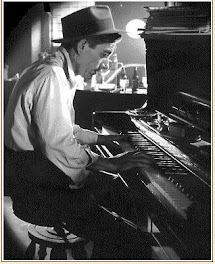
Here's one:  Adrien Brody.

In The Pianist, he's Wladyslaw Szpilman, a Jew in Nazi-ruled Poland, a man socially restricted and marginalized, his family sent off to their death in camps, he himself for years hidden in Warsaw. 


No film can handle the reality of such powerlessness and brutality.  This film, by Roman Polanski, himself a boy in Warsaw then, suggests the accidentalness, the luck, involved.  The world around is being destroyed.  It's Brody's sensitivity and quiet that holds his sanity in place.  

And it's his music (not to be blithe about the mega-death of that war) that suggests some kind of transformative value to it all.

We're still working that out.  Hence, the actual Szpilman performing for years afterward.  Hence, Polanski with his deeply ironic cinema.  Hence, the much younger Brody channeling that experience for us.


.

Saturday, September 18, 2010

Listen. Do You Want To Know A Secret?


Although titled 'T.S. Eliot', the video's reader is Michael Gough, a British actor whose imdb CV fails to show an appearance on one or some episodes of The Loretta Young Show in the 1950s where I remember Loretta featuring him as an honored player.

He's had a very durable career, and I do remember him in some of the horror films shown on his list and also in the more somber or sinister roles he's otherwise done.

Here he voices Eliot's 'Prufrock', a modern fool for love, a model of dull despair, of loneliness, a manipulee in the sophisticated hands of sexual puppetry, ripe for risible gossip, a man deadened to the prospect of anything but ironic response to his outreach.

When a trained British actor -- Gough, in this instance -- recites that which is -- though memorable on the page, in the mind's ear -- depressing, it is the high delivery that carries the poetry to us.  Consonants crackle and pop and kick.  Vowels open abysses and squeeze to a shriek.  All that within a classical containment.

Americans.  I'm one.  We do not have this music.  Our English can be welcoming or plain-spoken or hushed or rowdy or sincere;  it can have brute poetry -- at its best, for example, in David Mamet.  Southerners come close to the lyricism:  Tennessee Williams, Capote, and (his greatness!) William Faulkner.  

Americans.  I'm one.  We do not have this music.  It's in our basic culture to despise aristocracy.  Try as British working class heroes might, in their closer resentment, want to make His Lordship or Her Ladyship kiss their own Arses, these mates are still rooted more directly to Shakespeare, his modeling of great mankind, than they may be comfortable to admit.  

His breath.  Shakespeare's breath.


.

Friday, June 11, 2010

Teacher Man


I lecture so much -- I perform so much -- that I run out of throat.


.

Tuesday, December 8, 2009

Thursday, October 15, 2009

Nothing To Be Done


Beckett On Film.

The difference between theater and cinema.

These films, done by a dozen (or two dozen?) directors.

Plays, originally. Films now. No 'filmic' director would experiment so; these tried holding true to drama, which is to say, words and gesture and tradition of thematic depth.

Exploration, sure, not just 'stage'.

Absences, sure, audience and players years and miles apart.

Intellectual edge.

Beckett's humor. Oppressive. Pathetic. A wry reality dressed down.

Sunday, December 14, 2008

Self-Esteem


Sometimes I shake my own hand, just at the honor to have known me.

Thursday, November 6, 2008

Shapeshift


Sometimes I move like a cat

Sometimes a rhino

The genius lies in an absence of mind

Saturday, August 30, 2008

Act-Tor


To establish 'character':


looks
expression
bearing
gestures
intonation
silences

Monday, May 26, 2008

". . . The Kindness Of Strangers"


As the story went according to my boyhood friend Mike, his neighbor M__ H__, a 'second lead' in one of the second-rank studios, entertained ladies quite a bit, and Mike would peek out the window, sometimes with binoculars, to get a load of who the new invitee was.

One day a young lady exited early one morning when Mike happened to be in his own driveway near the front lawn. The actor banged open his screen door and started playing with his penis, calling out to the girl by name and imploring her to come back.

Our adolescent circle didn't drop this story for weeks, howls turning into pushing-and-shoving laughter and imitation, then simply to the coded winks of those in-the-know.

Decades later the incident took on different meaning. Things connected up in my head. When he had called her by name -- Stella -- he must have been aping Brando in A Streetcar Named Desire.

I should also wonder whether my adolescent friend actually just saw M__ H__ tear at his T-shirt.